NVIDIA is the most complete and profitable AI infrastructure platform today, but we see it as an execution-led, high-quality cyclical company rather than a permanent monopoly. The investment needs AI usage and customer revenue to grow faster than compute unit costs fall; NVIDIA must retain system value as custom chips expand; and its supply commitments, equity investments, cloud capacity and guarantees must not feed back against shareholders.
01 · The thirty-second answer
If you read only one section, read this one. The rest of the note explains these four answers.
It sells a platform for running AI
NVIDIA designs GPUs, networking, rack systems and software that help customers build AI datacentres faster. Chips remain central; the full system reduces integration work and deployment risk.
Datacentre is about 92.5% of revenue
Q2 FY2027 revenue was $96.2 billion, including $89.0 billion from Datacentre. A 75% GAAP gross margin shows that customers currently pay heavily for scarcity, performance and speed to deployment.
Customer returns, platform share and buildout risk all work
AI usage must keep growing; custom chips must not remove too many high-value workloads; and NVIDIA's commitments to supply and ecosystem expansion must be absorbed by real end demand.
The base case meets the hurdle, with little cushion
Starting from the 31 August 2026 close of $220.78, our three-year stress test is about −17% a year in the bear case, +9% in the base case and +34% in the bull case. Base only matches our roughly 9% hurdle.
02 · What does NVIDIA actually sell?
The GPU is the entry point, not the whole product. NVIDIA's advantage is co-designing four layers so that customers can make expensive equipment productive sooner.
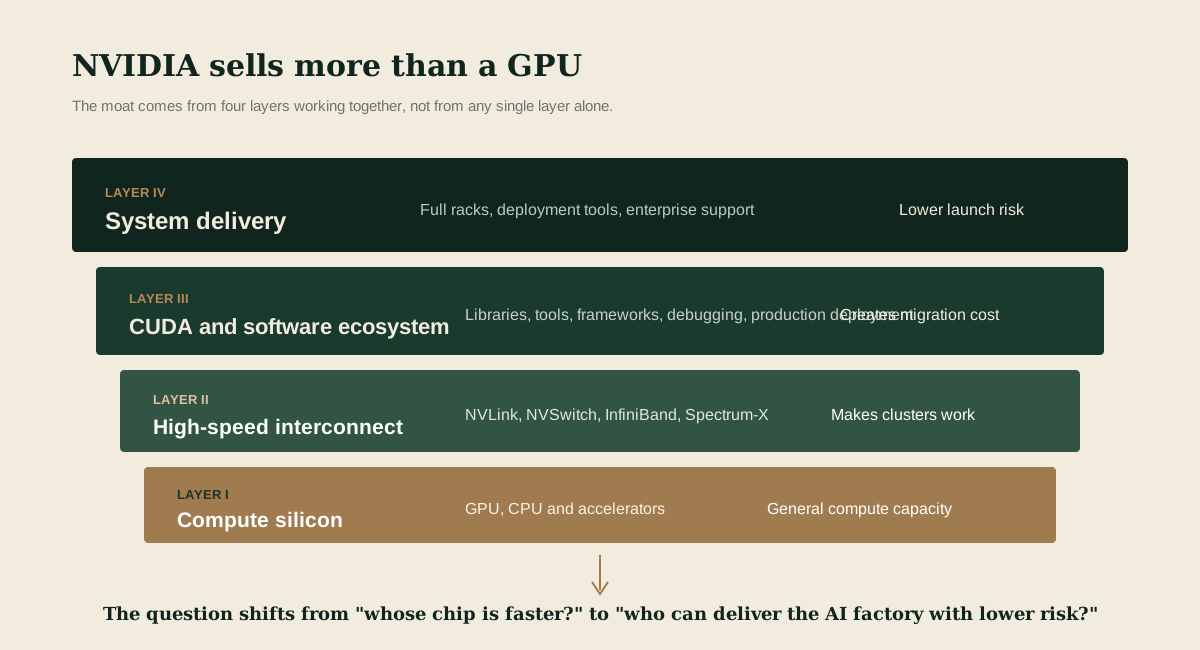
GPUs process many calculations in parallel and are central to training and running AI models. NVIDIA also designs CPUs and other components, but does not operate a leading-edge foundry.
NVLink, InfiniBand and Spectrum-X help thousands of chips work together. In a large cluster, slower networking wastes expensive compute.
Customers can buy chips, boards, networking or more complete rack designs. “AI factory” is NVIDIA's term for a large datacentre used to train and run AI.
Developer tools, libraries and available engineering skills make the platform easier to use. Switching hardware can require changes to code, tools and team workflows, creating migration cost.
Why can a fabless company earn such high margins? NVIDIA designs the most valuable chips, systems and software, outsources manufacturing, and charges for scarce performance and faster deployment. That does not remove manufacturing risk: leading-edge wafers, HBM memory, advanced packaging, networking and rack components all come from external supply chains.
Do not misread software revenue: CUDA matters enormously, but NVIDIA does not disclose a large standalone subscription stream comparable with Office. Software mainly makes the hardware and systems easier to sell, supports pricing and raises switching cost.
03 · Where does the money come from?
NVIDIA is now overwhelmingly a datacentre company. Gaming remains meaningful, but it no longer drives the valuation.
| Q2 FY2027 | Amount or rate | How to interpret it |
|---|---|---|
| Total revenue | $96.221bn | Up about 106% year over year; demand is still growing at an extraordinary rate. |
| Datacentre revenue | $89.023bn | About 92.5% of revenue, concentrating the company in AI infrastructure. |
| GAAP gross margin | 75.0% | Pricing, product mix and scarcity are exceptionally strong; normal supply can change this. |
| GAAP operating margin | About 66.2% | Far above ordinary hardware economics and a powerful incentive for customers to build alternatives. |
| Non-GAAP EPS | $2.22 | Closer to operating earnings, but from FY2027 this measure includes share-based compensation and is not directly comparable with older periods. |
In the first half of FY2027, operating cash flow was about $74.4 billion and purchases of property, equipment and intangibles were about $4.4 billion, leaving simple free cash flow near $70.0 billion. The product business throws off enormous cash. NVIDIA also bought about $42.4 billion of equity securities. That is not operating capex and should not be subtracted mechanically from free cash flow, but it still uses shareholder cash.
Pre-tax income included roughly $23.7 billion of net gains on equity securities; only the after-tax portion flows into net income. Reported EPS is therefore not all repeatable operating profit. For valuation, we focus on normalised operating EPS and free cash flow per share rather than one quarter of investment marks.
Two classifications cannot be added: NVIDIA reports Compute & Networking and Graphics segments, while also disclosing Data Center and Edge Computing market-platform revenue. The same product can appear in both views.
04 · What is our investment case?
The case is not “AI will grow, therefore NVIDIA wins”. Three conditions must hold at the same time. Failure in any one can turn an excellent company into a losing share.
- AI usage and customer revenue grow faster than chip efficiency and unit compute prices fall
- As custom silicon expands, NVIDIA retains enough share and profit through software, networking and system delivery
- Supply, equity, cloud-capacity, lease and guarantee commitments are absorbed by third-party demand and become free cash flow per share
Why is more AI usage not enough?
Each chip generation does more work, and cloud prices can fall. New use cases and total usage therefore need to grow faster. Customers may continue a strategic buildout before revenue is obvious, but they cannot indefinitely spend more than AI revenue and cash flow can support after depreciation, power and capital costs.
Why does custom silicon not need to beat GPUs everywhere?
Google TPUs, Amazon Trainium, Microsoft Maia and other custom chips only need better economics on large, repetitive and stable workloads to take meaningful volume. NVIDIA's defence is not that customers can never leave. It is lower total cost and deployment risk for changing workloads that need flexible software, multi-cloud access and complete systems.
Why has the latest capital structure changed the risk?
NVIDIA historically sold equipment while customers bore datacentre returns. It now also reserves supply, buys cloud capacity, invests in parts of the ecosystem and provides conditional guarantees to selected projects. This can speed deployment, but it also makes orders, investment values and counterparty performance more likely to move together. The clearest new loop is that partner clouds buy NVIDIA systems while NVIDIA commits to buy their capacity; the commitment declines only as third-party customers or NVIDIA's own research actually use that capacity.
05 · What is proven, and what is not?
| Question | Current view | Evidence and boundary |
|---|---|---|
| Is demand real today? | Yes, and exceptionally strong | Revenue grew 106% and Datacentre 117%; next-quarter revenue guidance is about $108 billion. Current orders do not prove long-run customer return. |
| Will customers pay a platform premium? | They do today | A 75% gross margin and roughly 66% operating margin show outstanding pricing and mix. Normal supply may change both. |
| Is roadmap and system execution working? | Evidence is positive | New compute, networking and rack platforms keep moving into production. Execution must be re-earned each generation. |
| Will customers earn back the buildout? | Not proved | Clouds rarely isolate AI revenue, while capex includes land, power, networking and traditional cloud. Public data cannot produce a clean return calculation. |
| How much moves to custom chips? | Not proved | Large clouds are both customers and competitors. The outcome depends on total cost and software migration, not only peak chip speed. |
| Can ecosystem support feed back against owners? | The risk has risen | Supply, cloud capacity, equity, leases and guarantees have all expanded. They differ and cannot be simply added, but collectively increase cycle feedback. |
06 · Valuation: is a great company worth the price?
This is a transparent historical stress test, not a price target. The scenarios have no reliable probabilities. Their purpose is to put operating assumptions, valuation and shareholder return in one table.
Define the starting point
The test starts at the $220.78 close on 31 August 2026 and ends on 31 August 2029, ignoring the small dividend. Q2 FY2027 non-GAAP EPS of $2.22 annualises mechanically to $8.88, or about 24.9× the starting price. It is a one-quarter run rate, not a full-year forecast, and it does not adjust for the extra week in the 53-week FY2027.
| Scenario | Business outcome | 2029 assumption | Scenario price | Three-year CAGR |
|---|---|---|---|---|
| Bear | Buildout slows; stable workloads move to custom chips; margins fall; supply and investment arrangements come under pressure. | Normalised EPS $8 × 16 | About $128 | About −17% |
| Base | AI demand keeps growing but normalises; platform advantage remains while margin and valuation step down. | Normalised EPS $13 × 22 | About $286 | About +9% |
| Bull | Customer AI revenue appears; NVIDIA captures high-value growth; third-party demand gradually replaces ecosystem support. | Normalised EPS $19 × 28 | About $532 | About +34% |
How to read the table: the bear case does not require AI to disappear. Operating earnings merely stall and the market values NVIDIA like cyclical hardware. The bull case implies a market value above $12 trillion at roughly today's share count, so scale itself becomes a constraint. The true tail can be below $128; the scenarios cannot be averaged without defensible probabilities.
The base path returns about 9% a year, only matching our minimum long-run hurdle while already assuming ongoing demand and no major platform damage. Bull upside is large; bear outcomes combine lower earnings and a lower multiple. For an investment now putting more shareholder cash and contingent credit into ecosystem expansion, the historical starting price leaves limited room for error.
07 · What makes the investment win or lose?
Technical leadership and share-price return are different. NVIDIA can sell many more chips and still disappoint a price that expected even more.
Usage, customer revenue and platform value compound
Usage grows faster than efficiency; customer cash supports more building; custom chips take only bounded stable workloads; gross margin stays around 70% or higher; normalised EPS and free cash flow per share rise.
The company stays excellent as growth normalises
Datacentre keeps expanding and the platform leads, but easier supply lowers margin and valuation. The business remains strong while shareholder return becomes ordinary.
Building outruns monetisation
Clouds reduce expansion; rental price and utilisation fall together; stable workloads move to custom chips; supply turns into inventory or impairment; and supported customers create order, investment and guarantee feedback.
Who records the depreciation?
Most GPU depreciation first appears on the books of cloud and datacentre customers, not in NVIDIA's current-quarter profit. It reaches NVIDIA when customers decide that revenue no longer covers depreciation, power and capital cost and cut the next purchasing cycle. We therefore study both NVIDIA's sales and the buyer's economics.
08 · How risks hurt shareholders, and what we watch
| Priority | Risk | Shareholder damage | What we watch |
|---|---|---|---|
| 1 | Customers do not earn back AI investment | Capex stays high for a while and then drops, hurting NVIDIA revenue, margin and valuation together. | Cloud disclosures on AI revenue and return, capex growth, and sustained GPU rental-price and utilisation trends. |
| 2 | Concentration and financing loops | A small set of customers or investees affects orders, receivables and investment values at the same time. | One direct customer was 16% of Q2 revenue; three were 16%, 15% and 13% in the first half. We watch terms, receivable concentration and disclosure of revenue from investees. |
| 3 | Custom chips take large workloads | TPUs, Trainium, Maia and other ASICs need not win everywhere; taking huge stable workloads can reduce growth and pricing power. | Cloud custom-chip deployment, software migration, defences such as NVLink Fusion, and actual training and inference share. |
| 4 | Commitments and guarantees feed back | Supply may become inventory or impairment; cloud capacity, leases, investments and guarantees consume more cash when counterparties weaken. | About $279bn of supply and capacity commitments, $29bn of cloud-service agreements mainly for NVIDIA's own R&D, $25bn of unfinished equity commitments and $25bn of uncommenced leases mainly for engineering and R&D. Separately, $36bn of AI-cloud agreements involve partner clouds buying NVIDIA systems while NVIDIA commits to capacity; $20bn of uncommenced leases are intended for third-party assignment; and conditional guarantees have maximum nominal exposure of about $108.5bn. The categories differ and may be related, so they are not one debt figure. |
| 5 | Execution, supply chain and key person | A missed generation, foundry/HBM/packaging disruption or poor succession can quickly weaken an execution-led moat. | Production ramps, yields, inventory preparation, supply prepayments, rack delivery and succession. |
| 6 | China and geopolitics | Export controls reduce the available market and accelerate local substitutes; concentrated Asian supply creates tail risk. | China Datacentre shipments were below 1% of the quarter and Q3 guidance assumes no China compute revenue; we watch licences, product rules and geographic supply concentration. |
Commitment convention: supply, internal cloud services, AI-cloud agreements, equity, own-use leases, intended third-party leases and guarantees have different terms, timing and triggers, and some may be related. Maximum guarantees are staged and contingent, not current losses. Adding everything into one liability exaggerates risk; ignoring all of it understates the capital cycle.
We use four consecutive quarters, not one presentation. If Data Center growth, margin and operating cash flow per share step down together; customer capex weakens; inventory and receivables keep rising; and supply and guarantee exposure do not contract, we would move from “high-quality cycle still expanding” to “the capital cycle is feeding back”. More custom-chip share alone would not break the case if NVIDIA's system profit and free cash flow per share still grow.
09 · Sources, estimates and notice
Financial data are from NVIDIA's Q2 FY2027 disclosures; this note was updated on 2 September 2026. The valuation stress test uses the 31 August 2026 historical close. Market prices and disclosures change, so the scenarios cannot be applied mechanically to today.
- NVIDIA Q2 FY2027 results for revenue, market platforms, margin, EPS and guidance.
- NVIDIA Q2 FY2027 Form 10-Q for full statements, customer concentration, cash flow, investments, supply, leases and guarantees.
- NVIDIA FY2026 Form 10-K for the business, supply chain, risk factors and historical conventions.
- Q2 FY2027 CFO Commentary and earnings-call transcript.
- NVDA historical prices for the split-adjusted 31 August 2026 close.
Our estimates: simple free cash flow, annualised EPS, three-year scenarios, normalised earnings and multiples are not NVIDIA guidance. Our interpretation of commitments and guarantees is also judgement; maximum nominal exposure is not a certain loss.
This note is general research and information only. It is not investment or financial product advice, a recommendation, an offer or solicitation. Past performance is not a guide to future results.